Why can't you split your technology costs by product?
Sydney, Australia
Sam Russell, Product Lead

You know your gross margin by product, getting there meant deciding, line by line, which costs move when volume moves and which do not, and you have been making that call on every line of cost of sale for as long as you have done the job. Materials move, the lease does not, the warehouse team is fixed until the day it is not, and knowing roughly where that day sits is part of what makes the margin defensible rather than merely calculated.
Technology looks like it should be no different, and at first glance it is not, the invoice already separates committed spend from consumption. Reserved instances, contracted floors and annual licences sit on one side, on-demand compute and inference on the other, and any controller who has read a cloud bill for more than a quarter can point at the line where one becomes the other. Nobody needs a platform to find that.
So the split exists, it is simply the wrong one.
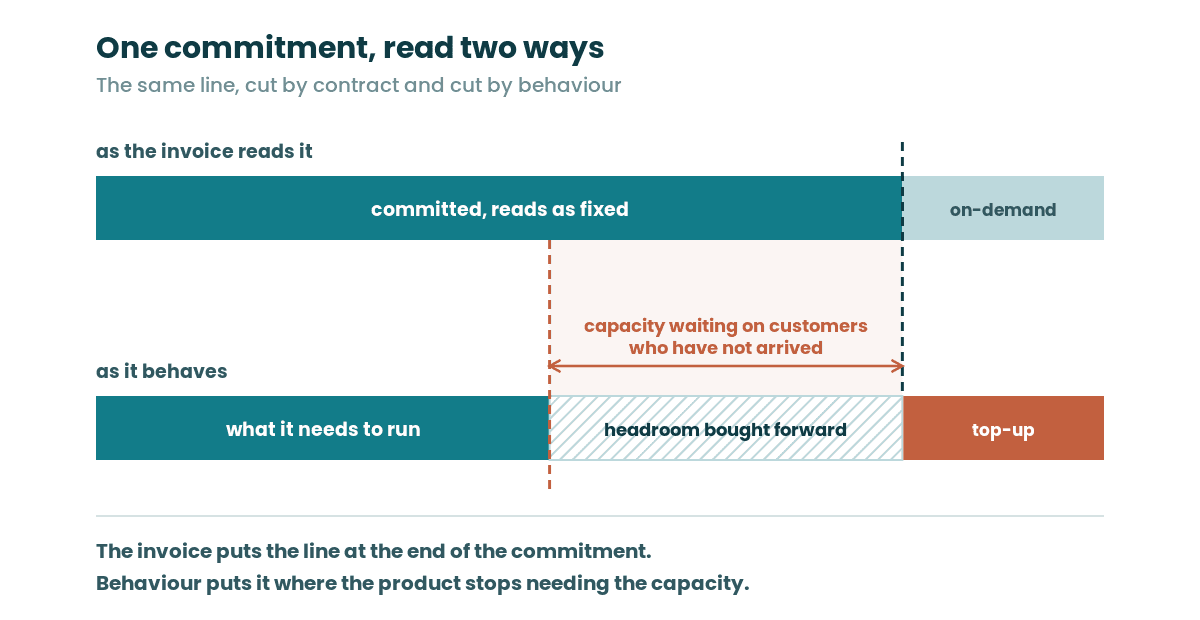
What the invoice gives you is a split by commercial arrangement: how you agreed to pay, not what the money does, a three-year commitment tells you the payment is fixed, it does not tell you that the workload underneath it scales with the number of customers you serve, which makes the underlying cost variable and the contract merely a smoothing device. On-demand spend tells you the payment moves, it does not tell you whether it moves with your customers or with a nightly batch job that would run identically if you lost half of them.
Every other line splits by what it does, technology splits by who you signed with.
Both cuts are real, only one of them is a cut through your products, and a decision about a product needs the cut that follows the product.
The reason the useful one is missing is not a failure of accounting, whether a cost behaves as fixed or variable is decided by architecture: by whether the resource was provisioned ahead of demand or consumed in response to it, and by which feature reaches for it when a customer arrives. That fact lives in the system, it is simply not written down anywhere finance can see.
The poles are clean and much of an estate sits between them, autoscaling provisions in response to demand, multi-tenant infrastructure serves several products out of one pool, and reserved capacity is amortised across whatever happens to consume it. Which is why the behaviour is worth measuring.
The contract split is available because a commercial arrangement is recorded where finance already works, the product split is unavailable because an architectural decision is not, and no amount of care reading the invoice recovers something that was never in it.
None of this mattered very much while the number was small, a cost line you cannot decompose is tolerable when it sits below the threshold at which anyone would question it, and technology spent two decades comfortably below that threshold, apportioned across products by headcount or revenue share, reconciling every month, queried by nobody.
That threshold has been crossed, Gartner has revised its 2026 IT spending forecast upward three times in nine months, from 9.8 per cent growth last October to 14.2 per cent in July, reaching $6.37 trillion, with AI spending alone forecast to grow 47 per cent this year. The repeated revisions are the more telling number: this is a line that has outrun the people whose job is to predict it, a share of cost that behaves like that stops being something you apportion and starts being something that decides whether a product is profitable.
Which is where the missing cut costs you something specific, you can defend a price without it, because you can always point at the total, what you cannot do is answer the question underneath the price: at twice the volume, does this product's margin improve, hold, or quietly invert. If the technology inside it is largely fixed, scaling is the whole strategy and every additional customer is close to pure margin, if it is largely variable, growth buys you revenue and very little else, and the discount you were considering at the next renewal takes the product below water at exactly the volume you were hoping to win. Those two products can carry an identical technology cost this month and want opposite decisions.
Consider a product whose technology line is four fifths committed, which on the invoice reads as fixed, a commitment is rarely sized to what a product needs to run, it is sized to what somebody forecast it would need with headroom bought forward to earn the rate. So part of that fixed-looking figure is capacity waiting on customers who have not arrived, and the rest gets topped up on demand as they do. Once the line is split by product the cost is visibly moving with volume, the contract is only smoothing the payment, and the volume deal the team had on the table at a 15 per cent discount goes below break-even at roughly the volume it was written to win.
Getting that cut is not a matter of labelling costs, nothing sensible would ask a controller to accept a system's opinion on whether a cost is fixed, and OPTIMAZE does not offer one. What it does is supply the observation the judgement has always needed. Attribution traces spend to the product that caused it, which is the cut contracts cannot give you, and a unit economic expresses that attributed spend against the product's own activity. Tracked across periods, it produces the same product's cost at different volumes, and you read the behaviour off it the way you read it off any other line: cost per unit that holds as volume rises is variable, cost per unit that falls has something fixed underneath it.
The figure moves for reasons other than volume, a commitment renews, a rate changes, an engineer replaces a service with a cheaper one. Those are real events rather than measurement error, and separating them is the ordinary business of explaining a variance with more than one cause, which your team already does on every other line. An apportionment offers nothing to separate, because it has no causes in it at all.

A CFO reading this will say, correctly, that price follows value, it is set by what a customer will pay and what the alternatives cost them, and a business that prices off its cost base is describing a commodity. All true, and a different question. Cost tells you whether the price you already set still works at the volume you are trying to reach, and that is a question the person who set the price cannot answer alone.
Technology spend has become large enough to decide whether a product makes money, it should be legible enough to say which one.
That is what OPTIMAZE calls Technology Capital Performance.
If this sounds like something you or your business needs, get in contact with our sales team.
In short
You already split cost of sale by behaviour. Which costs move when volume moves and which do not, decided line by line, and knowing roughly where a fixed cost stops being fixed is what makes the margin defensible rather than merely calculated.
Technology looks like it has that split and does not. The invoice separates committed spend from consumption, which is a split by commercial arrangement: how you agreed to pay, not what the money does.
A commitment tells you the payment is fixed, not the cost. The workload underneath it can scale with customers, which makes the underlying cost variable and the contract a smoothing device. On-demand spend tells you the payment moves, not whether it moves with customers or with a batch job indifferent to them.
The useful split is missing for a structural reason, not an accounting one. Whether a cost behaves as fixed or variable is decided by architecture, and architecture is not written down anywhere finance can see. The contract split is available because a commercial arrangement is recorded where finance already works.
It did not matter while technology spend was small. Gartner has revised its 2026 IT forecast upward three times in nine months, to 14.2 per cent and $6.37 trillion, with AI spend forecast to grow 47 per cent. The repeated revisions are the more telling number.
What the missing cut costs you is one specific question. Not whether you can defend a price, you always can, but whether this product's margin improves, holds or quietly inverts at twice the volume. Two products can carry an identical technology cost this month and want opposite decisions.
A commitment is sized above what a product needs to operate. Headroom is bought forward to earn the rate, so part of the fixed-looking figure is capacity waiting on customers who have not arrived, and the rest gets topped up on demand as they do.
Attribution plus a unit economic produces the behaviour read. The same product's cost at different volumes, tracked across periods: cost per unit that holds as volume rises is variable, cost per unit that falls has something fixed underneath it. OPTIMAZE supplies the observation, the judgement stays with the controller.
Cost does not set the price, and it was never claimed to. Price is what a customer values and what the market will bear. Cost tells you whether the price you already set still works at the volume you are trying to reach.
Subscribe to our blog.
Never more than once a week.