What is Unit Economics for technology spend?
Sydney Australia
Sam Russell, Product Lead

TLDR: Just speak to our sales team.
Finance teams understand what unit economics are; cost per acquisition, cost to serve, cost per unit produced, it's how a business checks whether an activity is worth doing, not just how much it costs. What's changed is where that discipline now needs to apply, technology spend; cloud, & AI, are the platforms sitting beneath the products a company sells, and have grown into one of the largest and least quantified lines on the P&L. It gets reported, but it rarely gets measured the way the rest of the business is.
The reason is structural, A factory has an obvious unit: one widget, one cost to produce it. A cloud bill has no equivalent. It's a single figure covering dozens of teams, products, and workloads, and working out what it produced means first working out whose it was. Attribution has to happen before unit economics can. You cannot divide spend by customers served if you don't yet know which spend belongs to the product those customers use. AI usage compounds the problem, since it scales with usage in ways that are far easier to lose track of than traditional infrastructure spend, OPTIMAZE solves this problem, our Attribution engine keeps a handle on this ownership so you don't need to.
Tech spend is like dark matter: you know it exists, you can't see it, and you can’t measure its impact on individual products and teams. (Without OPTIMAZE)
Reduced to its essentials, unit economics is quantification, applied with discipline. It replaces "this system probably pays for itself" with a figure that can be pointed to, tracked over time, and defended in a budget conversation like any other line. Producing that figure requires two components: attributed spend as the numerator, and a defensible measure of business activity as the denominator, customers served, transactions processed, active users, revenue generated. Both matter equally. A ratio built on a rough estimate of either side isn't one finance can rely on. Once cost per specified unit exists as a tracked figure rather than a spreadsheet rebuilt each quarter, it behaves like any other KPI: monitored continuously, compared period to period, and flagged the moment it moves the wrong way.
This is also what changes the ROI conversation, return on technology investment stops being a judgement call, "this platform seems to be paying off", and becomes something with a trend line attached to it. Cost per unit falling while output rises is a return, in the same sense any other capital investment produces one. Cost per unit rising while output stays flat is the opposite, and it's visible immediately rather than at the point a finance team finally reconciles annual spend against annual growth.

The same ratio has benefits elsewhere as well, once cost per customer is known and reliable rather than an estimate, pricing stops being guesswork, a margin can be set against an actual cost rather than an assumed one. Indeed, because the ratio is tracked continuously rather than recalculated once a year, it becomes the basis for financial forecasting as well: project the trend forward and next quarter's cost per unit is a financial projection, not a guess based on what the bill happened to be last time.
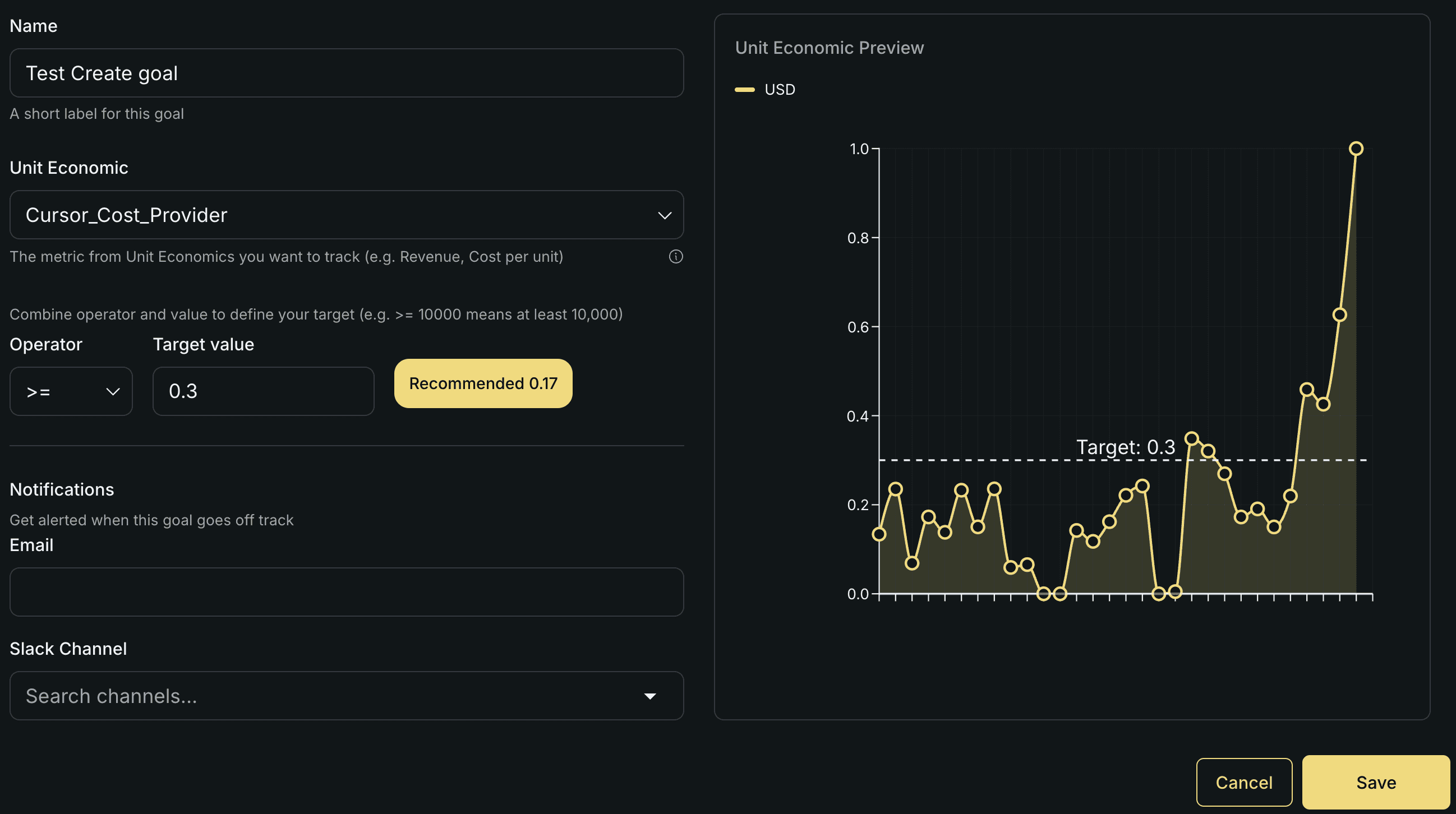
Within OPTIMAZE, this tracking is native rather than manual: a quantified unit economic can be set directly as a Goal, a performance target tracked against that ratio, updating on its own as the underlying cost and usage data changes. Set a target for cost per customer once, and there's nothing to rebuild each month to check whether it moved.
Unit economics is one instrument within a larger discipline, not the whole of it. It sits alongside attribution, which establishes where spend actually goes, and budgets and goals, which establish whether that spend is tracking to plan. Together, they answer a single question: for what a business spends on technology, is it getting a proportionate, attributable return, and can it see that clearly enough to act on, rather than finding out after the fact.
That question is what OPTIMAZE calls Technology Capital Performance. Unit economics, quantified properly, is the part of it that turns "we think this is worth it" into a number finance can stand behind.
Subscribe to our blog.
Never more than once a week.