What is Attribution?
Sydney, Australia
Sam Russell, Product Lead

What is attribution, and what does it mean for you?
Most finance teams have some form of cost allocation for technology spend. A bill arrives, someone from finance pays for it, and the problem goes away for now. But does it explain why the cost has changed? Which product does it belong to? Did the cost go up due to increased adoption? Does the cost actually reach the people responsible for causing it? In most cases, the answer to all of them is absolutely not. This is the problem OPTIMAZE is designed to resolve.
Attribution is the causal link between spend and the thing that produced it. It's built from the workload upwards rather than the invoice downwards: a resource attributed to the product it serves, an inference call attributed to the feature that triggered it, a query attributed to the service that made it. The result is a cost that can be taken apart, here is the spend, here is the workload that caused it, here is the product that owns it, here are the vendors that the product uses, here is the team that owns the product. Allocation answers how to split a number, attribution answers what caused it, and while that may seem semantic the difference is fundamental: an attributed cost informs decisions in a way an unattributed one struggles to.
Unattributed spend is just a hidden tax paid by the finance team for the speed of the engineering team
The clearest symptom of its absence is accountability without granularity and certainly no accuracy. By example, a CTO/Head of Engineering is handed a figure they can neither verify nor detail, they know the total charged to them, they don't know whether it reflects one inefficient product, a step change in AI usage within a user subscription cohort, the impact of a new product sent to market. You know what the cost is and you can do nothing about it, because you have not attributed it. A cost attributed to your business model (e.g. products), can be read from an engineering view and a finance or go-to-market view at the same time, which is the point at which margin becomes something a business manages rather than something it observes.
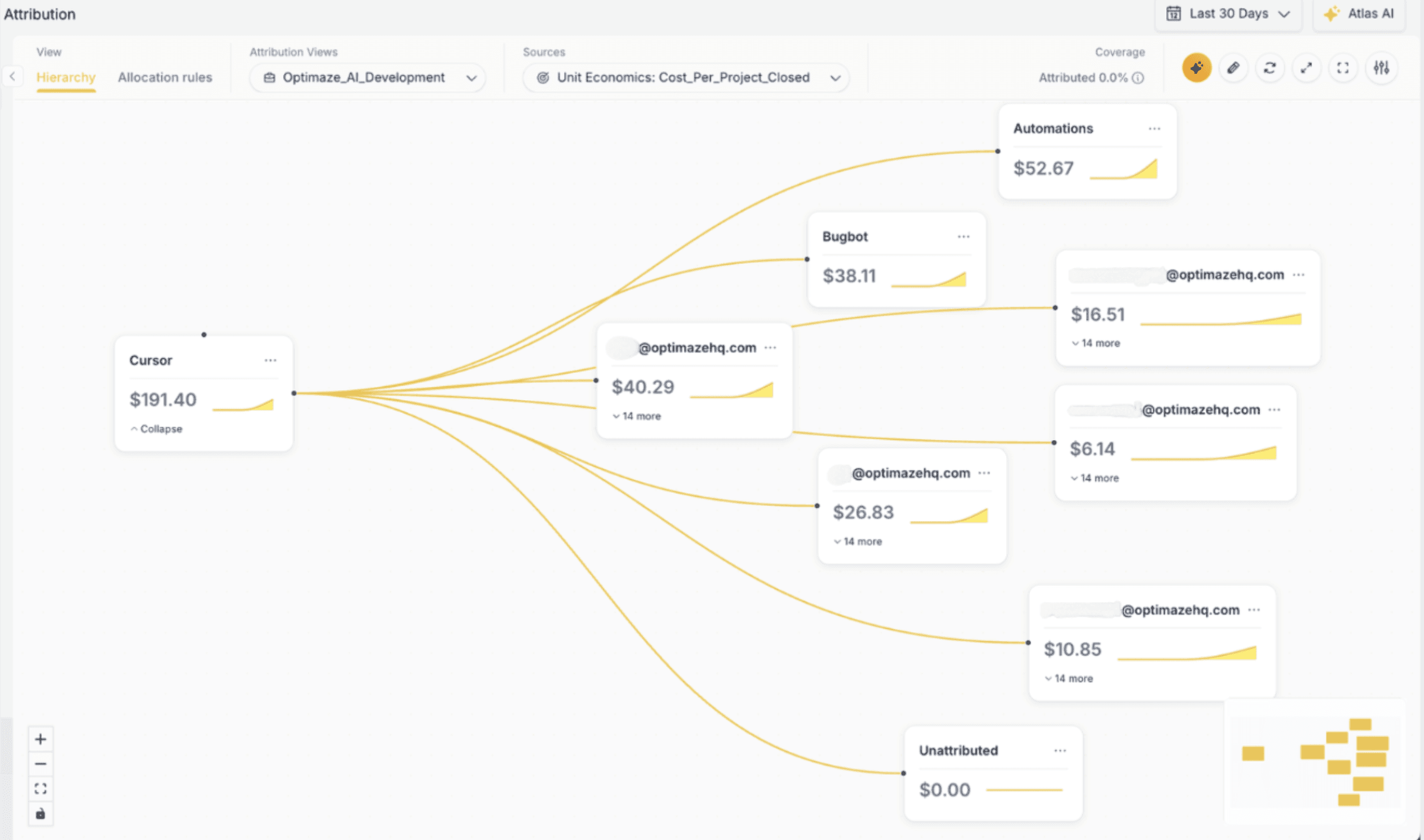
Attribution is also what makes cost per unit meaningful. Cost per customer, cost per transaction, cost per feature, each divides spend by a measure of business activity, and each needs attributed spend on the top of that ratio. A departmental figure doesn't describe what any individual product costs to run, it describes what that department costs to run, and dividing the second number by customers served produces something that looks like a unit cost but without attribution provides something hollow. We've written separately on what unit economics means for technology spend, but the dependency runs one way: the ratio is only as defensible as the attribution underneath it.
None of the above makes allocation unwanted or unneeded, some spend genuinely has no single owner, shared platform services, observability tooling, enterprise licences, the infrastructure every product depends on and none of them causes alone. Single ownership models only scale so far. The OPTIMAZE attribution model allows you to decentralise ownership, and where cost genuinely needs re-allocating, shared platforms being the obvious case, allocation does real work. This is why it sits inside OPTIMAZE as a first-class capability: allocation rules distribute genuinely shared spend across cost centres on a consistent, agreed basis, so a cost centre view reconciles to the total while the attributed detail underneath it stays intact. Allocation applied on top of a well attributed estate is a reporting decision. Allocation applied instead of attribution is a guess wrapped in a spreadsheet.
Enabling financial transparency [means] shifting from asset‑level tracking to outcome‑driven metrics, so stakeholders see spend in the context of the business capabilities it enables.
Gartner: CIO Playbook for Smarter IT Cost Management
The problem with tagging:
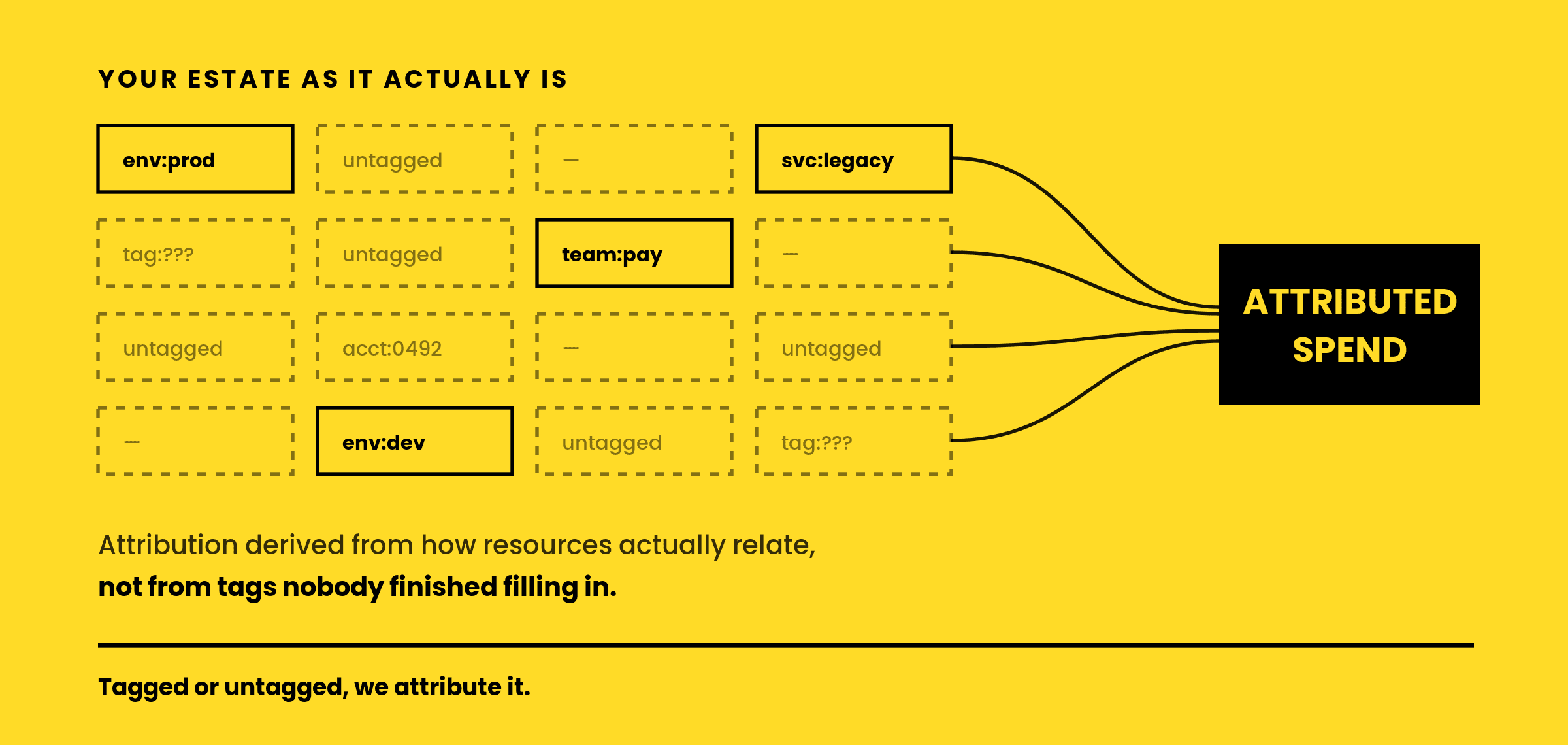
The usual objection to reaching an attributed view of that reflects a businesses financial model (e.g. Product), is that it demands a tagging discipline no real technology estate has. That's true of the theory and it's why so many “tagging” projects stall, waiting on a tagging standard that never fully lands across every account, subscription, and legacy workload. OPTIMAZE is built for the estate as it actually is, we derive attribution from the relationships between resources, and any other relevant metadata, rather than depending on every resource carrying a perfect tag, so a finance team gets a defensible view of what their technology produced without a multi-year data hygiene programme in front of it. Tagging improves the picture, but it is neither the price of admission on OPTIMAZE, nor necessary to understand an attributed view of your estate on our platform.
Spend decisions happen at the engineering level, often without finance involvement... As the surface area grows, the accountability challenge compounds. You can't govern what you haven't assigned ownership for.
FinOps Industry Assessment
Even if you reach a perfectly tagged nirvana, the reality is, teams reorganise, products change, cost centres are redrawn, and an acquisition arrives carrying a tagging convention nobody else in the business uses. Fixed mappings start deteriorating the day they're set, which is why attribution in OPTIMAZE is maintained as rules over relationships rather than a static chart of accounts. Change the structures or the names, in your data or in our models, and our engine detects them, updating your model to reflect the estate as it evolves, so a reorganisation or an acquisition doesn't mean restating what you already reported.
That combination, attribution as the foundation and allocation as the layer above it, is what allows technology cost to behave like any other performance metric: tracked continuously, broken down however you see fit, and set as a target. A business that only allocates its technology costs knows where the money went on paper. A business that attributes them knows what the money produced. That second question, asked properly and answered with evidence, is what OPTIMAZE provides, a quantified view of the Technology Capital Performance of your business.
Intrigued? Get in contact with our sales team for a demo to see how OPTIMAZE can help you.
Subscribe to our blog.
Never more than once a week.