To defer or not to defer
Sydney, Australia
Sam Russell, Product Lead

The age of AI adoption at all costs is coming to a close. Anyone putting an AI proposal in front of a CFO this year likely met a harder question than the same proposal would have met eighteen months ago, and most people I talk to who work near a technology budget are feeling the squeeze, the time for returns has well and truly arrived.
What is less obvious is that two things are happening at once, and they point in opposite directions.
Spend is accelerating, Gartner has worldwide IT spending growing 14.2 per cent in 2026 to $6.37 trillion, AI spending up 47 per cent to $2.59 trillion, and AI-optimised infrastructure close to doubling. That IT spending figure has been revised upward three times in nine months.
Confidence is going the other way. Forrester's 2026 predictions find fewer than one-third of decision-makers able to tie the value of AI to their organisation's financial growth. Gartner surveyed 204 finance leaders in March and describes a "perception gap, where finance leaders report progress on AI adoption, but boards see limited strategic impact". In August, 55 per cent of chief supply chain officers said they were unclear on the return of their AI investments.
Forrester's conclusion is that enterprises will defer a quarter of their planned AI spend into 2027.
That is being read as rigour arriving. You do not fund what cannot be justified, withholding capital under uncertainty is what a serious finance function does, and after two years of approving on the strength of fear of missing out, the correction is overdue. Every part of that is defensible.
Capital preservation is the more accurate name for it, and capital discipline is a different posture with different requirements.
Capital discipline chooses well. Capital preservation chooses less.
Discipline requires knowing which of the things in front of you is working, and directing money towards it. That is a judgement, and making it needs evidence. Preservation requires none: it reduces the size of a position you cannot evaluate, which is a reasonable way to manage exposure and leaves the underlying investment unjudged.
Pausing spend reduces how much money is at risk. It generates no information whatsoever about the thing being paused. Nothing observed during a deferral tells you whether the deferred initiative was one of the ones working, so when the question returns in twelve months it gets answered from the same position of not knowing, with a year of compounding gone.
The other consequence is worse and it is the one nobody writes in the paper. A deferral has to select something, and selection falls to whatever is legible, since return is the one property unavailable: the largest line, the newest programme, the one whose sponsor argued least well, the one that has not shipped yet. Every one of those is uncorrelated with value. Applied across a portfolio, deferring on an absence of evidence removes the winners at roughly the rate it removes the losers.
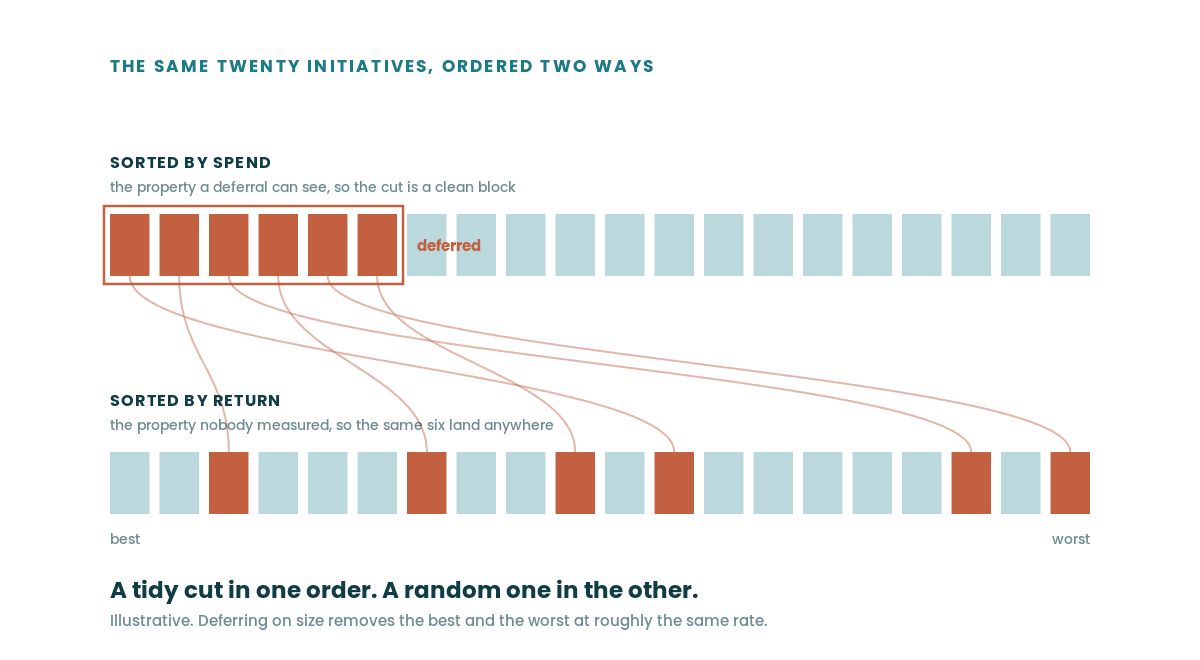
Consider what it means in a category growing at 47 per cent. Standing still while a market moves that fast is itself a directional bet, a wager that the payoff is absent, taken by someone who has just said, in the same breath, that they cannot see the payoff either way. Spending was a bet on the same missing evidence. Deferring feels safer because the money stays in the account, and the exposure has simply moved somewhere that does not show up in the budget.
What would make this a decision is the thing that has been absent from the beginning: knowing which of these initiatives produced something. Not adoption, not deployment counts, not pilots in production, but attributed spend expressed against the business activity it supported. Gartner's finance practice put it to a room of CFOs in May: 'They must not mistake activity for impact. Counts of pilots, tools rolled out or use cases in production show that finance is moving, but they do not prove that AI is delivering the value boards now expect.' The reason so many do is that activity is the only thing most organisations can currently count.
That is a measurement problem being treated as a budget problem. The budget response, applied to a measurement problem, produces a smaller version of the same uncertainty.
A business that cannot attribute its AI spend and chooses to defer is behaving rationally given what it can see. The deferral should simply be understood as what it is, a holding position taken because the evidence was never assembled, and the useful work is assembling the evidence to make informed decisions.
Attribution traces spend to the product or feature that caused it. Unit economics expresses it against what that product actually did. Together they turn next year's version of this conversation into a ranking, and a ranking can be acted on.
The businesses that come out of 2027 in better shape are likely to be the ones that spent the deferral period acquiring the thing that makes the next decision a decision.
That is what OPTIMAZE calls Technology Capital Performance.
If this sounds like something you and your team could use, get in contact with us.
Subscribe to our blog.
Never more than once a week.