Why don't your technology costs reconcile to a business unit?
Sydney, Australia
Sam Russell, Product Lead

Every business knows how to identify a transaction. An invoice arrives, someone assigns it a cost centre, a general ledger code, a department, and from that point on the number can be reported, compared, and questioned. The discipline is old, it is well understood, and finance owns it end to end.
Tagging is that same act, moved into the cloud and handed to somebody else. A tag is a label attached to a resource at the moment it is created, a key and a value, env:prod, team:payments, service:checkout, and it is very often the only surviving record of which part of the engineering team is responsible for it, not who is financially accountable. Nothing on the invoice bridges the two.
Which is where finance should start paying attention, because the coding is being done by an engineer, at provisioning time, in free text, with no chart of accounts to code against and no requirement to code at all. There is no validation step, no approval, and no equivalent of a rejected journal. An untagged resource still runs, still consumes, and still arrives on the bill, it simply arrives without an owner. OPTIMAZE treats that as a solvable problem rather than a permanent one, spend carrying no usable label is still attributed through the relationships around it, the accounts, services and metadata it sits within, rather than being left in a bucket marked unknown.
Untagged spend is the suspense account of the technology estate.
None of which makes tagging wasted effort. A well tagged estate is easier to reason about and worth the discipline it takes. But it has a ceiling, and the ceiling is the part finance should understand: a tag records what somebody intended a resource to be for, not what actually consumed it, and intent decays. Teams reorganise, products get renamed, an acquisition arrives carrying a convention nobody still at the business wrote, and the labels quietly stop describing the estate they were applied to. OPTIMAZE is built for that, structural change is absorbed as rules over relationships rather than requiring the estate to be retagged or the previous year to be restated.
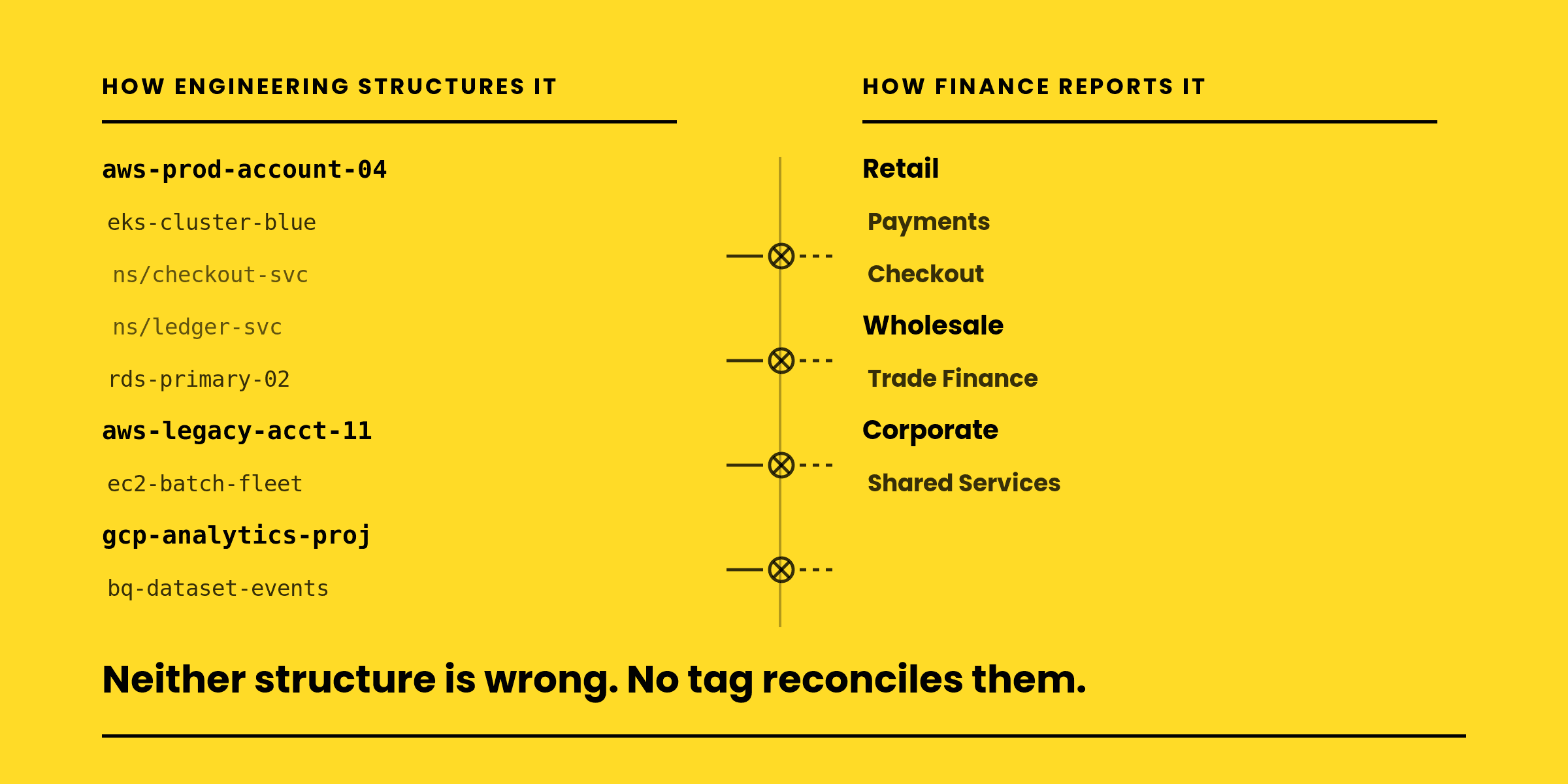
Indeed, it is worth stating plainly: OPTIMAZE doesn't need clean estate to attribute spend. Attribution is derived from how resources, accounts, services and any other available metadata actually relate to one another, which means a defensible and accurate view of the estate exists on an entirely untagged environment, and tagging done from that point on sharpens the picture rather than gating it.
What that changes for finance is who they have to depend on. Under a tagging model, a finance team cannot align technology spend to its own financial structure without first learning how engineering has chosen to label things, negotiating a convention that serves both, and then waiting for it to be applied across an estate they do not control. Finance ends up inheriting engineering's taxonomy of ownership and reporting through it. With derived attribution none of that is necessary. Spend is mapped to the financial model the business already uses, its products, cost centres and P&L lines, without finance needing to understand, approve or wait on how engineering names its resources. No taxonomy programme, no data hygiene exercise, and no dependency on another team's labelling discipline standing between finance and an attributed view of its own spend.
A business that depends on tagging alone can only report what its engineers remembered to label. A business that attributes its spend can report what actually happened. That difference, and the confidence it gives finance to stand behind a technology number, is what OPTIMAZE calls Technology Capital Performance.
If this sounds like something you or your business needs, get in contact with our sales team.
Subscribe to our blog.
Never more than once a week.