When does your subscription run out of margin?
Sydney, Australia
Sam Russell, Product lead

A subscription price is fixed for the length of the term, whether that term is a three-year enterprise contract or a rolling monthly plan someone can cancel from their phone, that is most of what the person paying it is buying, a known number instead of one they have to watch. Revenue behaves the same way from the business's side, it does not move on its own between renewals no matter what happens underneath it.
Margin against that subscriber is usually checked once, near signup, when the number is basically true, it describes them at the point they have used the least of what they are paying for.
For most of what a subscription has historically included, usage has a ceiling built into it. A seat is used by one person, roughly a working day at a time, a record is created once and then sits there, so cost grows slowly.
A generative feature folded into the same flat fee does not behave that way. There is no seat-like limit on how many images, drafts or answers one subscriber can pull from a model in a month, so the same flat fee can carry a subscriber who costs the business cents that month and one who costs several multiples of the fee, and nothing about signing up for the tier selects which one you get.
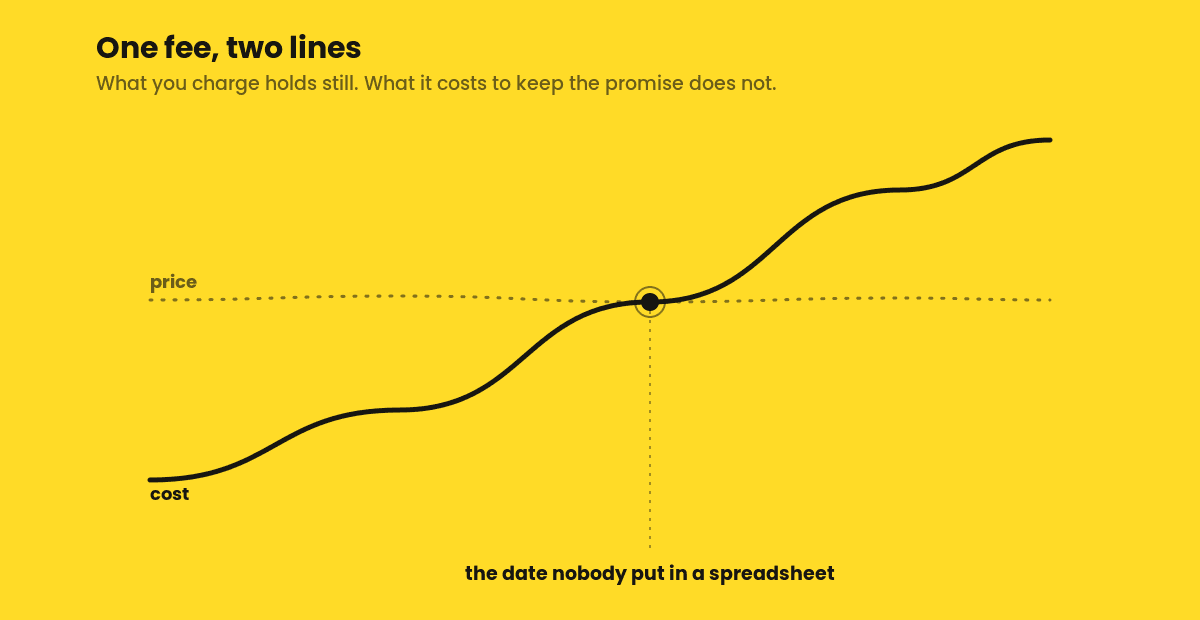
A subscription fixes what you charge, not what a model costs to answer the question underneath it.
Take a subscription tool whose middle tier bundles a limited allowance of AI-generated images into the flat fee. Most subscribers use a handful and stop, some use none of it at all, and a smaller group finds the one feature that actually costs money to run and leans on it daily, well past what the fee was ever priced to cover. All three signed up for the identical page. The cost behind it split three ways the moment they did.
That is the whole shape of the problem, wider now than it was when a subscription's variable cost was mostly seats and storage. Two subscribers on the identical plan, paying the identical price, can carry opposite outlooks depending on how heavily each one actually uses the feature bundled into it, and a margin taken once cannot see the difference between them. One is barely touching what they are paying for. The other is a habit that gets more expensive to host every month it continues, and it will cross the price it was sold at on a date nobody put in a spreadsheet.
None of this touches a feature that is rate-limited rather than flat and open, a fixed number of generations included each month behaves exactly like a seat, bounded and forecastable. The exposure is specific to a feature sold as though usage were bounded but metered as though it is not, and a business that cannot tell a heavy subscriber from a light one at the point they are billed is the one carrying the difference.
That makes it a trend question rather than a snapshot question everywhere it shows up, whether an enterprise account's usage or a consumer subscriber's habit is improving, holding or quietly inverting a margin as it climbs, and it needs the same read a variable cost gets everywhere else in the business, cost per unit, tracked across periods, not checked once at signup and filed.
OPTIMAZE attributes cost to the product and the customer generating it, whether that customer is a single enterprise account or one subscriber among many, so the cost per customer is something you can watch as it moves rather than something you find out about at renewal, or not at all.
Technology spend, and the inference spend now sitting inside it, has become large enough to decide whether a subscriber is still worth the plan they signed up for, it should be legible enough to say when that stops being true.
If this sounds like something you and your team could use, get in contact with us.
Subscribe to our blog.
Never more than once a week.